-
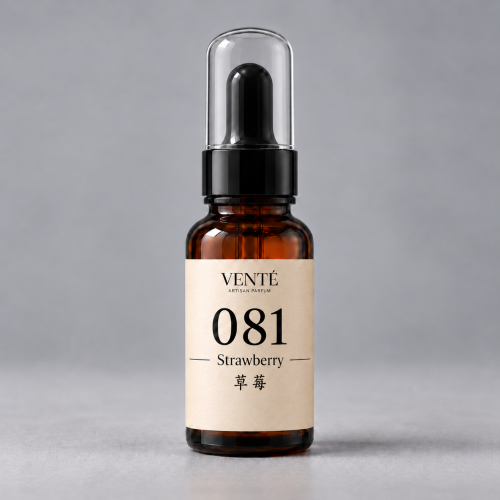 Strawberry belongs to Fragaria × ananassa, originally cultivated in Europe and the Americas through hybridization of wild species. In medieval Europe, strawberries symbolized purity and humility, often appearing in religious paintings and monastery gardens as signs of spiritual simplicity and natural grace. The ancient Romans valued wild strawberries for celebrations and traditional remedies, associating them with restoration and vitality. After the Age of Exploration, American varieties were introduced to Europe, increasing in size and sweetness, and gradually becoming a symbol of seasonal joy. Its aroma carries bright fruity sweetness with a gentle tart freshness, like sun-ripened fruit releasing its scent. Youthful yet soft, it expresses delight without excess. From monastery gardens to modern gourmand perfumery, Strawberry represents innocence, pleasure, and lighthearted emotional expression.
-
 Fig refers to Ficus carica, native to the Mediterranean and Western Asia, and one of the earliest cultivated fruit trees in human history. In ancient Egypt, figs were used in offerings and symbolized fertility and life. In Greece, they represented harvest and wisdom; Plato was even nicknamed a lover of figs. In biblical tradition, the fig tree symbolizes awakening and self-awareness, as its leaves were used to cover the body. In Buddhist symbolism, the Bodhi tree—belonging to the same genus—became a symbol of enlightenment. The scent of fig is layered and distinctive, blending green leafy freshness, creamy fruit sweetness, and soft woody undertones. It evokes not only the fruit but the entire tree—sun-warmed leaves, milky sap, and ripened flesh. From sacred offerings to philosophical meaning, Fig embodies abundance, awareness, and natural authenticity.
-
 Apple refers botanically to Malus domestica. Throughout human history, it carries layered symbolism. In Greek mythology, the golden apple of discord cast by Eris ignited rivalry among the gods and ultimately led to the Trojan War. In Norse legend, the goddess Idunn guarded apples that preserved youth and vitality. In biblical tradition, the apple is often associated with knowledge and temptation, symbolizing awakening and choice. In Celtic lore, Avalon—the isle of apples—represented healing and eternal paradise. By the medieval period in Europe, apples became emblems of love, harvest, and the natural cycle of life. Its scent is crisp and juicy, blending natural sweetness with bright acidity, reminiscent of autumn sunlight and freshly sliced fruit. Innocent yet tempting, simple yet mythic, Apple embodies vitality, knowledge, abundance, and the power of choice.
-
 In ancient Greek mythology, the pear was associated with Aphrodite, the goddess of love and beauty, symbolizing feminine curves and fertile vitality; from Mediterranean orchards to European royal courts, it became an emblem of refinement and sensual pleasure. Medieval monasteries cultivated pear trees in their herb gardens, believing the fruit carried soothing and restorative qualities, while Renaissance paintings portrayed its fullness as a sign of abundance and earthly delight. In modern perfumery, pear preserves this cultural lineage through its luminous juiciness, gentle sweetness, and subtle floral nuance; softer than apple and less voluptuous than peach, it balances freshness and tenderness with effortless grace, like a mythic offering of love that leaves a radiant yet understated sweetness upon the skin.
-
 Passion fruit derives its name from Spanish missionaries in South America who interpreted the intricate structure of the passion flower as a symbol of the Passion of Christ, giving the fruit a layered identity that merges faith and intensity; native to the Amazon and Andean regions, it was first valued by indigenous communities for nourishment and vitality before becoming an emblem of exotic warmth in Europe through maritime trade. Its scent is vibrant, tangy-sweet, and almost fermentative, carrying lush tropical juiciness with a subtle floral undertone; in perfumery, passion fruit embodies both the primal energy of tropical landscapes and the historical imprint of religious symbolism, standing apart from the lightness of citrus or the softness of berries, expressing instead a vivid, sun-drenched fruitiness that feels like humid air before a tropical storm—bold, radiant, and alive with movement.


10 Anson Road, International Plaza #03-30
Singapore 079903 (Tanjong Pagar MRT)
Mon – Fri 9.30am – 8.30pm
Sat/Sun/PH 9.30am – 6.30pm
© Copyright VENTÉ Perfume Studio 2026